
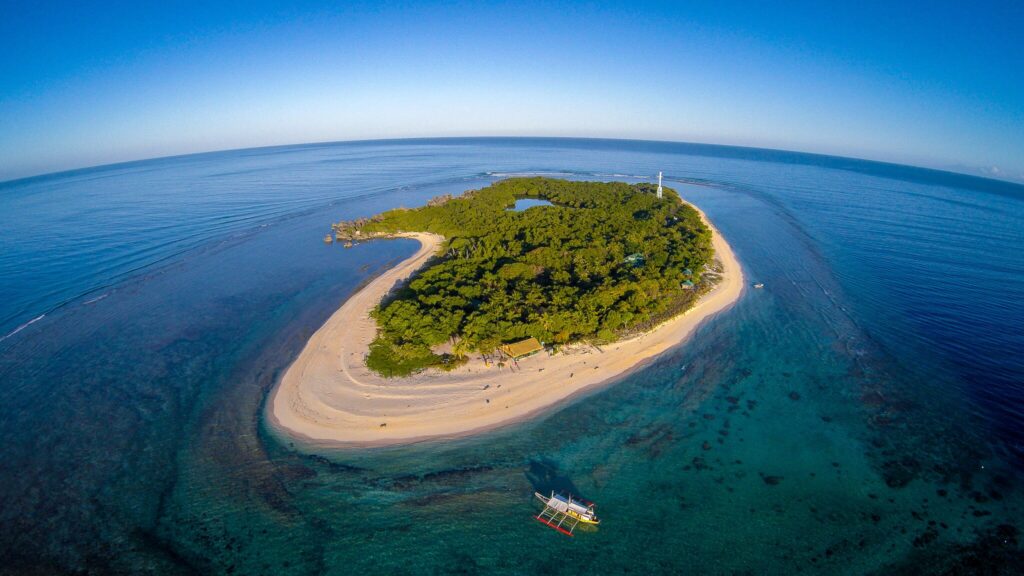
Apo Island, Philippines
I chose to write about Apo Island today, because I wanted to remind myself that nature is not just fragile, it is incredibly resilient when we give it a chance.
Growing up, I would hear stories from my mother about the Archipelago, the magical place of over 7,000 islands where each island held its own story. These stories however, not only included the immense beauty of the land of the Philippines, one of only 17 megadiverse countries, but the tension between how people were able to enjoy it and how the land would often become something of a distant relation, victim to commodification and destruction. Through typhoons, hurricanes, and commercialization of land, the land-use culture of the Philippines has changed drastically over the centuries, which include the colonial rule by Spain and the United States. These historic implications have changed people’s perception of the relationship between land and self drastically. With this in mind, how do you personally think about the land around you? What histories can you think of that affect your perception of land? While these questions may seem broad and overarching, how we think reflects where we come from, and in order to safeguard solutions for environmental protection, we must reckon with our own limitations and positionalities.
Because I am a second generation Filipina-American, I have continuously reshaped my relationship to the environment, through education, relationships and being exposed to new ideas. My Filipina heritage has connected me to familial relationships that have been built through time spent in the “bukid,” or countryside. Time spent here allows me to unwind the parts of myself that need to always be doing something, or that always need to be productive. In this way, the land has become a space for me to be my most relaxed self. And the people that I relax with in this environment share a kinship to the land around us; it is our sacred safe space. This contrasted with my view of land when I was younger: a track, a pool in the ground, roads and big buildings. All of these things were spaces that served only people, the wildlife that persisted here had evolved not because they wanted to, but because they had to.
Continuing to build on this idea of the perception of land, another critical question we can ask ourselves is what happens when we become stewards of the land? That is, when we try to change our perceptions or let them evolve past our own experiences.
Within Apo Island, an island in the Negros Oriental region of the Southernmost region in the Philippines, only 183 acres in size, contains an ongoing story that can begin to answer that question.
In the late 1970s, Apo Island was in a state of ecological collapse due to the fisheries culture that was dominating the food ecosystem in the region. This was due to the prevalence of dynamite and cyanide fishing, which are methods that provide immediate yield but cause irreversible structural damage to the calcium carbonate framework of coral reefs. This method included the stunning of fish by technologies that emitted harmful effects on local coral reefs. This led to a “trophic cascade” where the loss of apex predators and herbivorous fish allowed algae to smother the remaining coral. As a result, fishers faced the grim reality of overfishing and needing to go even ten kilometers further to get any traction of fish gains. Within this dynamic, an increasing number of fishers competed for a rapidly disappearing resource, which forced them to travel dangerously far into the open sea just to secure a subsistence catch.
Simultaneously occurring during this crisis, a prominent and growing force in the environmental field in the Philippines was helping to create legacies of barangay (community) led initiatives and MPAs (Marine Protected Areas). This was Angel Alcala, now passed, whose earlier work included the discovery of over 50 species of amphibians and reptiles within the Philippines, and who also eventually became the Secretary of the country’s Department of Environment Resources. Before working with Apo Island, he established one of the country’s first “no-take” zones, which were zones that strictly protected a reef area that would lead to a spill over of fish into surrounding waters. This solution posed that if 25% of a fishing area, which was the no-take zone, was strictly protected from any fishing activity, the remaining 75% could still provide a space where abundant catches could be made due to a “spill over effect.”
When he began to work with communities on Apo Island, he noticed that the people of the island had strong ideas to implement marine conservation strategies and were eager to implement a new Marine Protected Area in the south eastern part of the coral reef on Apo Island. This MPA was established in 1982, and it has been closely monitored ever since by the community of Apo Island itself. With their own initiatives and local led tourism, they have a deep connection and commitment to the ongoing MPA established protections.
Because of the stewardship of the Barangay in collaboration with Angel Alcala, the continuous monitoring of the “no-take” zones have taken Apo Island protection from being an MPA locally to a Protected Landscape and Seascape under the National integrated Protected Areas System (NIPAS Act), through the Presidential Proclamation No. 438. Following the history of Apo Island’s conservation crisis beginning in the 1970’s, we can see that a community led initiative eventually gained enough traction to receive formal support and protection from the national government, bridging local and national interest to protect coral reefs and its biodiversity. Notably, the Philippines hosts 421 species of Coral Reef, and Apo Island holds 400 different species of coral, showing its importance and criticality.
Looking at the results over the past decades, recent peer-reviewed research in the Bulletin of Marine Science (2025) highlights a multi-decadal recovery of fish biomass, proving that the sanctuary of the no-take zone acts as a larval foundational exporting ground. This is further supported by findings in Nature (via PMC), which identify Apo Island as a global “bright spot.” These findings support the success of the no-take zone, as the “spillover effect” has proven itself in full force. The spillover effect is that while the sanctuary reaches its carrying capacity, adult fish migrate across the boundaries into the 90% of the waters where fishing is permitted. This creates a win-win scenario where the sanctuary stabilizes local food security while simultaneously rehabilitating the wider marine ecosystem. Locals over the decades have even noticed a shift in fish populations and sea turtle populations, where once they were disappearing, now green sea turtles can be seen even just 10 feet from the shore feeding on local coral reef systems and fish are now abundant within the no-take zone. This has led to the healing of the coral reef systems, and even more notable is the new presence of the Hawksbill turtle species which is a critically endangered species of sea turtle.
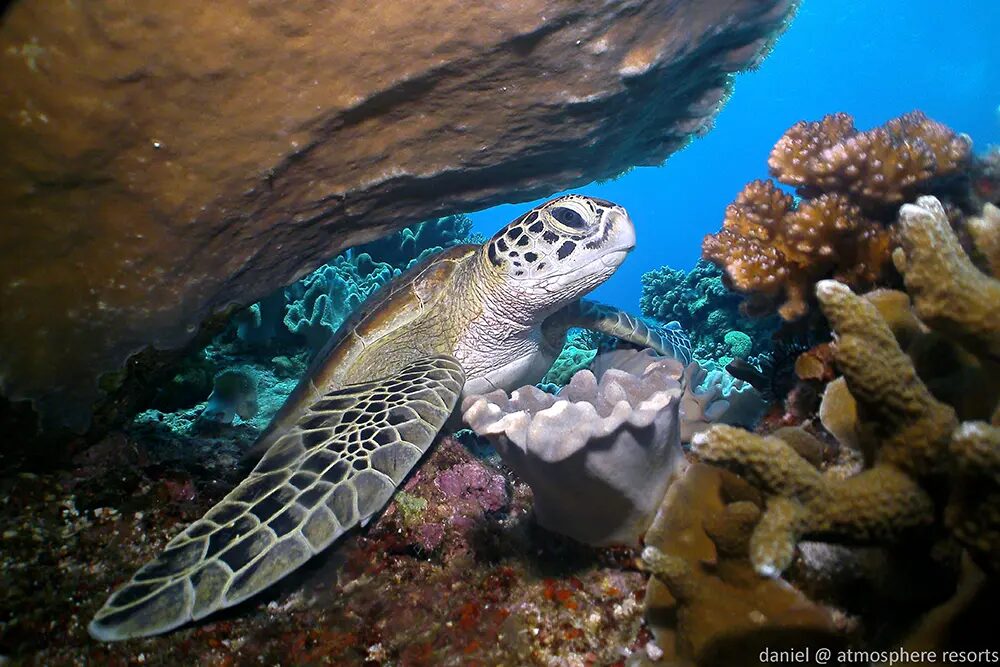
Green sea turtle on Apo Island, taken by Daniel @atmosphere_resorts
Because Apo Island has transformed from a once overfished environment to a healing space for biodiversity, ecotourism has also risen and taken the place for the biggest source of economy for the island and its communities. Tourists visit Apo Island for snorkeling and scuba-diving, and it is even listed in prominent scuba organizations as one of the top 100 places to scuba-dive. While this is the case, the juxtaposition of tourism and healing biodiversity continues to exist under stringent guidelines. Here is a quote from one environmental leader of the area:
Tourism is the primary driver for economic growth in places that have protected areas.” Says one of the environmental leaders in the Philippines, Dev Albao, ”The problem is, Tourism is also what destroys.”
While the transition to ecotourism from a fishing industry has allowed Apo Island to heal its approximate coral reel ecosystems, there still needs to be a critical analysis of what this new transition could entail for new environmental concerns. This could include the development of hotels, or the runoff of sunscreen, or noise pollution.
“Mahalaga ang pawikan para sa kabuhayan namin dito,” says Kuya Justin, which translates to “The sea turtles are very important to our livelihood here in Apo.”
Apo Island, while it is a place for hope in how resilient the environment can be when given the chance (in just 40ish years it has gained massive progress!), it now remains in a new delicate position, caught at the crossroads between preservation and the pressure to continuously earn.
As noted by Renzo Maano on Medium, the shift of ecotourism as the main source of GDP on the island “introduces a commodification of nature that carries its own set of risks.”
When I think about this implication, I go back to the question I asked before delving into the histories of Apo Island and its conservation: What happens when we become stewards of the land?
We each hold our own histories in connection to the land. This is critical to remember and think about as we interact with land where we are new to. If we think about our own relationships with the land, we can have a greater understanding and respect to how special land is to local residents as well as how we can best interact without exploitation and disregard.
With this in mind, here is a new question that can be posed to those that want to travel to Apo Island, or other places where ecotourism has become its main source of income: Is the environment serving the tourism industry, or is the tourism industry serving the environment?
In order to protect critical ecosystems, we must face our own positionality and continue to build relationships with people around the importance of respecting each other’s stories in connection to the environment. Only then can we begin to heal our understandings passed down to us that the land isn’t alive. As we can see from Apo Island, when given the chance to breathe, life comes back and continues to thrive as the stewards of Apo continue their mission.
References
Alcala, A. C., Russ, G. R., & Bucol, A. A. (2025). Long-term recovery of coral reef fish biomass in the Apo Island marine sanctuary. Bulletin of Marine Science, 101(1). https://doi.org/10.5343/bms.2024.0019
Cinner, J. E., Huchery, C., MacNeil, M. A., Graham, N. A. J., McClanahan, T. R., Maina, J., … & Mouillot, D. (2021). Bright spots among the world’s coral reefs. PMC – Nature, 535, 416–419. https://pmc.ncbi.nlm.nih.gov/articles/PMC8382879/
Maano, R. (2023, October). The success of Apo Island: Sustainable marine tourism done right. Medium. https://medium.com/@content.renzomaano/the-success-of-apo-island-sustainable-marine-tourism-done-right-5215c00aa74b
Marine Conservation Philippines. (n.d.). Location: Apo Island. https://marineconservationphilippines.org/location/apo-island/
University of Southern California. (n.d.). Apo Island Marine Sanctuary: A history of community-led conservation. Tropical Marine Protected Areas. https://scalar.usc.edu/works/tropical-marine-protected-areas/app-island-marine-sanctuary